
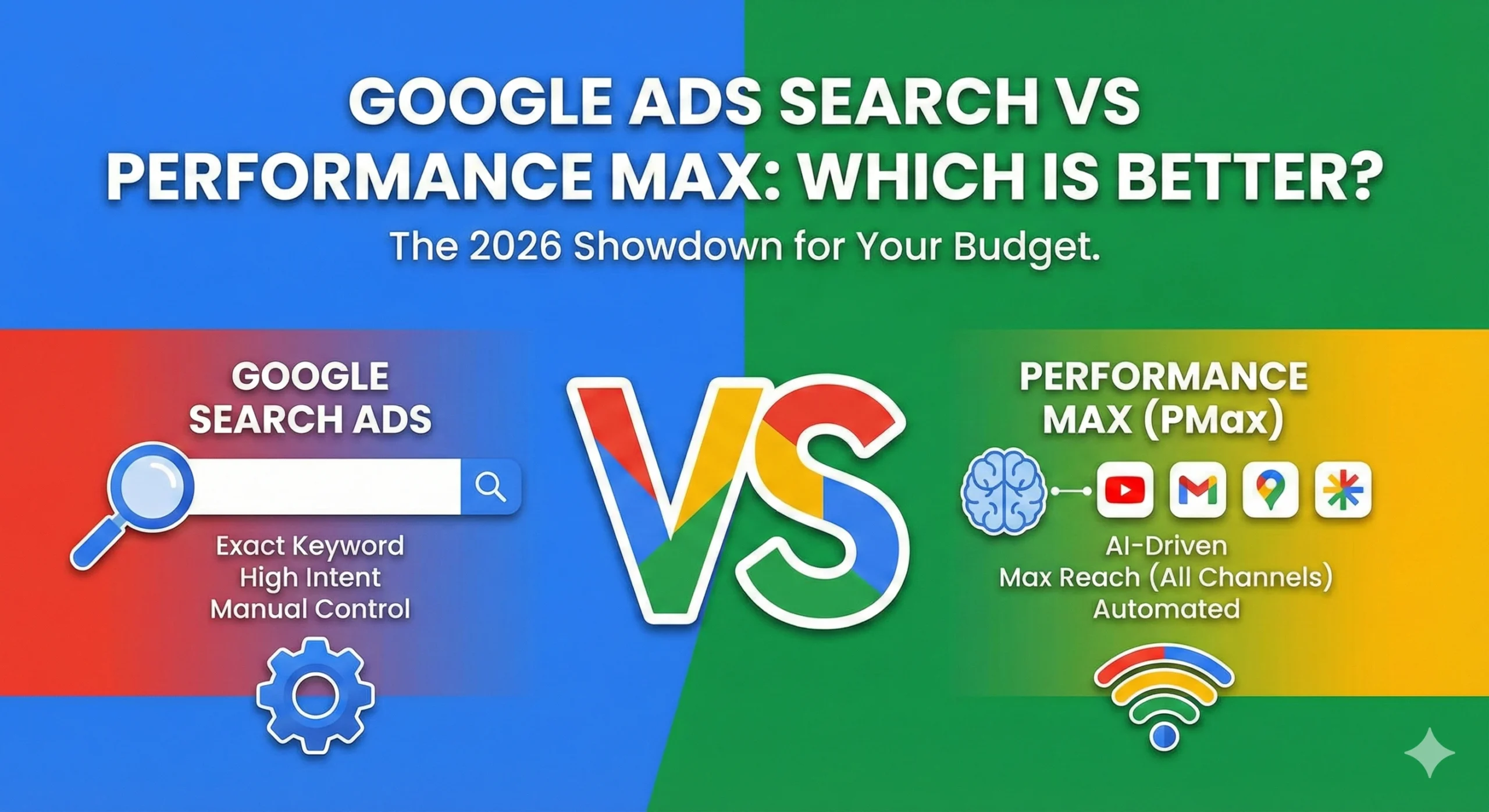
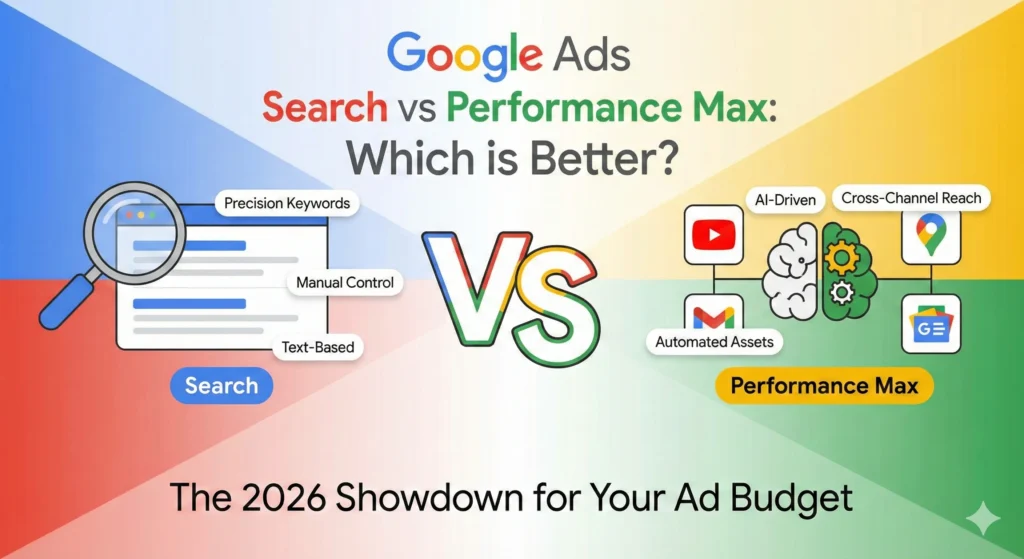
If you hang out in any digital marketing forum or Facebook group, you will see the same fight breaking out every single day.
In the red corner, we have the “Old King”: Google Search Campaigns. Reliable. Precise. The tool that built the Google empire.
In the blue corner, we have the “New Challenger”: Performance Max (PMax). AI-driven. Flashy. The mysterious “black box” that Google wants everyone to use.
And the question everyone is asking is: “Google Ads Search vs Performance Max: Which is better?”
If you ask a Google rep, they will tell you to put 100% of your budget into Performance Max. If you ask an old-school PPC expert, they will tell you Performance Max is a scam that wastes your money on junk traffic.
So, who is right?
The answer, as usual, is “It depends.” But “it depends” isn’t helpful when you are trying to decide where to put your credit card.In this guide, we are going to strip away the hype. We are going to look at the data, the mechanics, and the strategy. By the end of this post, you won’t just know the difference in the Google Ads Search vs Performance Max battle—you will know exactly which one to choose for your specific business.
Table of Contents
The Fundamentals: What are we actually comparing?
Before we declare a winner in Google Ads Search vs Performance Max, we need to understand the fighters.
Search Campaigns are “Keyword-Based.” You give Google a list of words (e.g., “emergency plumber near me”). When someone types that exact phrase, your text ad appears. It is simple. It is high-intent. You are targeting a specific action.
Performance Max is “Goal-Based.” You don’t give PMax keywords. You give it a goal (e.g., “Get Sales”) and a bunch of assets (images, videos, headlines). Then, Google’s AI takes those assets and hunts for customers across all of Google’s inventory. This includes:
- Search
- YouTube
- Display
- Gmail
- Google Maps
- Discover Feed
So, when we talk about Google Ads Search vs Performance Max, we are really comparing “Sniper Rifle” (Search) vs. “Shotgun” (PMax).
One is about hitting a specific target. The other is about hitting everything in the area.
The Case for Search: Precision & Control
Let’s start with the classic. Why do marketers still love Search campaigns in 2026?
1. You Control the Intent
With Search, you know exactly what the user wants. If they type “buy red running shoes,” they are ready to buy. You aren’t guessing. This makes Search incredible for lead generation and service businesses where intent is everything.
2. You Don’t Need Creative Assets
Not every business has a videographer or a graphic designer. Search campaigns only require text. You can write a winning ad in 5 minutes. (If you haven’t set up your account yet, check out our Google Ads Setup Guide for the basics on writing text ads).
3. Negative Keywords Actually Work
In Search, if you add “free” as a negative keyword, your ad will not show for searches containing “free.” You have absolute control over where your money goes.
The Downside: Search is expensive. Everyone is bidding on those same high-intent keywords. The Cost Per Click (CPC) can be brutal.
The Case for Performance Max: Scale & Automation
Now, let’s look at the challenger. Why is Performance Max taking over the world?
1. It Finds Customers You Couldn’t Find
Search waits for people to type a keyword. PMax goes out and finds them. It uses “Audience Signals” to find users who might be interested, even if they haven’t searched yet. It acts a lot like a social media funnel. (Ideally, you want to understand full-funnel marketing, which we covered in Meta Ads Funnels Explained.
2. It Leverages All of Google
Your single campaign shows up on YouTube, Gmail, and Maps. This gives you massive reach. For E-commerce brands, PMax is often a money-printing machine because it puts your product photos everywhere.
3. Automation Saves Time
You don’t need to manage 50 different ad groups. You feed the AI, and it optimizes bids, placements, and creative combinations for you.
The Downside: It is a “Black Box.” You often can’t see where your ads showed. Did you get a conversion from a high-quality Search click or a low-quality misclick on a mobile game app? PMax often won’t tell you.
The Comparison: Channels, Targeting, and Creatives
To settle the Google Ads Search vs Performance Max debate, let’s break down the mechanics side-by-side.
1. Channels
- Search: Google Search Engine & Search Partners.
- PMax: Search, YouTube, Display, Discover, Gmail, Maps.
- Winner: PMax for reach, Search for relevance.
2. Targeting
- Search: Uses “Keywords” (Phrase, Exact, Broad).
- PMax: Uses “Audience Signals.” You tell PMax, “My customers look like people who visit these websites,” and the AI uses that as a starting point to find similar people.
- Winner: Search for specific problems; PMax for broad audiences.
3. Creatives
- Search: Headlines and Descriptions only.
- PMax: Requires Headlines, Descriptions, Logos, Images (Landscape, Square, Portrait), and Video.
- Winner: If you have great visuals, PMax wins. If you don’t, Search wins. (Note: PMax fails without good visuals. You absolutely need to review our guide on High-Converting Ad Creatives before launching PMax).
The “Cannibalization” Risk (Do they steal from each other?)
This is the biggest danger in the Google Ads Search vs Performance Max battle.
“If you run both campaigns at the same time, [recent industry data on search term overlap] proves that PMax will often steal traffic right out of your Search campaign.”
Why? Because PMax includes Search inventory. If you have a Search campaign targeting “Nike Shoes” and a PMax campaign selling “Nike Shoes,” Google will often give the impression to PMax because it has a higher ad rank potential (due to historical data or AI bias).
The Result: Your Search campaign looks like it’s dying. Your PMax campaign looks like a hero. But in reality, PMax just stole the easy conversions that Search would have gotten anyway.
The Fix:
- Brand Exclusions: In your PMax settings, exclude your own Brand Name. Force PMax to go find new customers (Cold Traffic) and let your Search campaign handle the people searching for your name (Warm Traffic).
- Asset Group Themes: Ensure your PMax asset groups don’t overlap too heavily with your core Search keywords.
Scenario Guide: When to Use Search vs PMax
Still confused? Let’s make it simple. Here is a cheat sheet for the Google Ads Search vs Performance Max decision.
Scenario A: The Local Plumber (Service Business)
- Goal: Emergency phone calls.
- Budget: Limited ($50/day).
- The Choice: Search.
- Why: When a toilet is leaking, people search “plumber.” They don’t watch YouTube videos about plumbing. You need high intent. PMax will waste your budget on Display ads that generate low-quality leads.
Scenario B: The Fashion Brand (E-commerce)
- Goal: Sales of a new sneaker line.
- Budget: High ($500/day).
- The Choice: Performance Max.
- Why: Fashion is visual. You need to show the shoe on Shopping, Instagram-style feeds (Discover), and YouTube. Search text ads can’t show how cool the shoe looks. PMax is the clear winner here.
Scenario C: The B2B SaaS Company (Software)
- Goal: Demo Bookings.
- Budget: Medium.
- The Choice: Hybrid.
- Why: Use Search to capture people looking for “CRM software.” Use PMax (with strict exclusions) to retarget people who visited your site but didn’t convert, finding them on Gmail or YouTube.
In the Google Ads Search vs Performance Max decision matrix, lead quality favors Search, while volume efficiency favors PMax.
The Hybrid Strategy: How to Run Both Successfully
The smartest marketers don’t choose. They use both.
A holistic strategy doesn’t view it as Google Ads Search vs Performance Max; it views it as a tag team.
Step 1: Build the Foundation with Search Start with Search. It’s safer. Use our Google Ads Setup Guide to build a tightly structured campaign targeting your highest-intent keywords. Get some sales. Prove the concept.
Step 2: Scale with PMax Once Search is maxed out (you are getting all the possible clicks for your keywords), launch PMax.
- Feed PMax the data from your Search campaign (using the “Customer List” audience signal).
- Tell PMax: “Go find more people like the ones who bought from my Search campaign.”
Step 3: The “Guardrails”
- Add your Brand keywords as negatives to PMax.
- Monitor “Asset Group” performance.
- Watch your Lead Quality. PMax is notorious for spam leads. If you see spam increasing, tighten your audience signals or switch back to Search.
This Hybrid approach gives you the precision of the Sniper and the coverage of the Shotgun.
Conclusion: The Verdict
So, in the battle of Google Ads Search vs Performance Max, who wins?
- For Beginners: Search wins. It is easier to understand, safer for your budget, and easier to fix if it breaks.
- For E-commerce: Performance Max wins. It is the gold standard for online shopping in 2026.
- For Lead Gen: Search wins on quality; PMax wins on volume (but requires heavy filtering).
My advice? Don’t fall in love with the technology. Fall in love with the result.
Start with Search to protect your downside. Layer in Performance Max to explore your upside.
The best advertisers in 2026 aren’t dogmatic. They don’t religiously pick a side in the Google Ads Search vs Performance Max debate. They test. They measure. And they let the data make the decision.
Are you Team Search or Team PMax? Or have you found a way to make them play nice together? Let me know your experience in the comments!

wish you best and best