Here is a brutal truth about doing business in 2026: Invisibility is expensive.
Recent data shows that nearly 50% of all Google searches now have “local intent.” Yet, a staggering number of small businesses are still relying on SEO tactics from five years ago.
If you aren’t showing up in the “Map Pins”—those top three results on Google Maps—you aren’t just missing traffic. You are compensating your almost 70% of your potential revenue to your competitors. Let’s fix that today.
For professional local SEO services – Boost Hive Digital
Introduction: The Modern Way We Find Everything
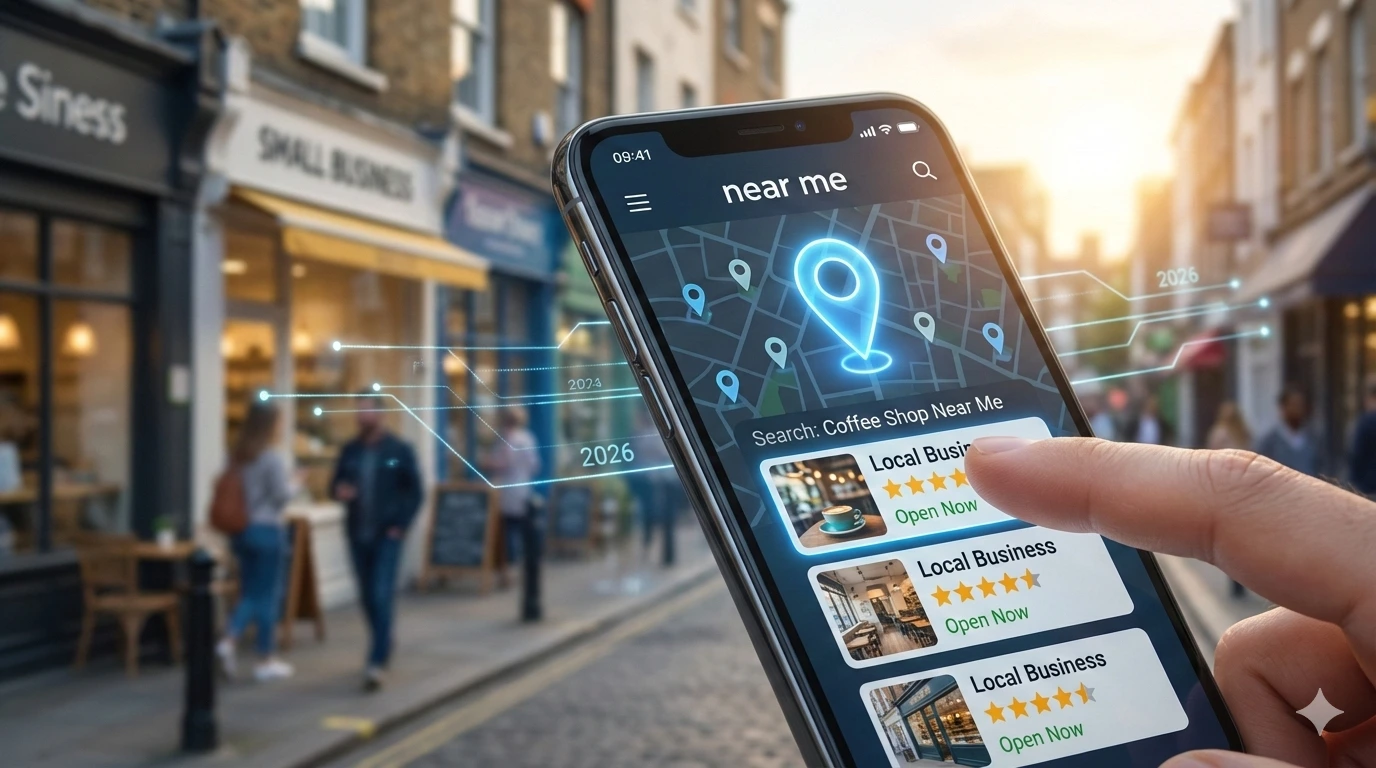
Imagine this scenario: It’s a hot afternoon, and your air conditioning suddenly breaks down. You don’t open a phone book. You don’t look for a flyer in your junk mail. You grab your smartphone and type (or say), “AC repair near me.”
Within seconds, you have a list of options. You glance at the star ratings, check who is open right now, and make a call. The business that shows up at the top of that list gets your money.
This process happens millions of times a day for coffee shops, dentists, lawyers, and plumbers. This is the world of local SEO.
If you have ever felt overwhelmed by digital marketing terms, take a deep breath. Local SEO is the process of helping your neighbourhood customers find you when they need you most. In 2026, the competition to be that “top result” is tougher than ever, but it is not impossible.
In this guide, we are going to walk through exactly how local SEO works today in plain English, why it is critical for your survival, and simple steps you can take to win.
What Changed? Why “Near Me” is Different in 2026
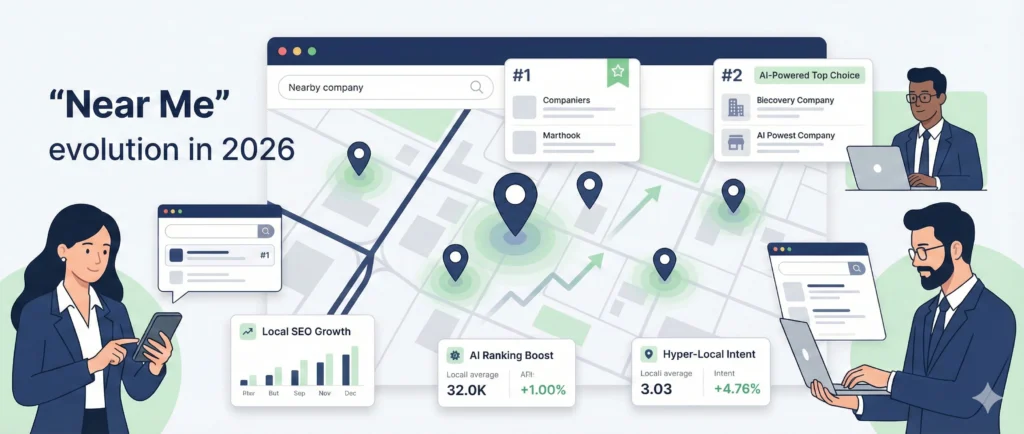
A few years ago, if you wanted to find a pizza place in Delhi, you had to type “Pizza place Delhi.” Today, you don’t need to do that. You just type “pizza.”
Search engines like Google have become incredibly smart. They know exactly where you are standing. They know if you are walking or driving. They know if you prefer deep-dish or thin-crust based on what you searched for last week.
The Shift to “Intent”
This evolution means that local SEO isn’t just about keywords anymore; it is about intent.
- Buying Intent: The customer wants to buy something now.
- Location Intent: The customer wants something close by.
Because search engines are so good at predicting this, the results page has become very crowded. Big brands and small local shops are fighting for the same tiny space on your phone screen.
If you ignore local SEO, you are essentially invisible to the people walking right past your store. But when you get it right, you connect with customers exactly at the moment they are ready to spend money.
AI and “Zero-Click” Searches: What Do They Mean for You?

You might have heard about Artificial Intelligence (AI) taking over the internet. In the world of local SEO, this has created something called the “Zero-Click Search.”
What is a Zero-Click Search?
Have you ever search on Google like “When does the pharmacy close?” and seen the answer pop up in big bold text at the top? You saw “9:00 PM,” so you didn’t need to click on the pharmacy’s website. That is a zero-click search.
For business owners, this can feel scary. You might think, “If they don’t click my website, how do I sell to them?”
Here is the good news: In local SEO, a zero-click search is often a win. It means the customer got your phone number, your address, or your hours immediately. They are likely on their way to you, even if they didn’t visit your homepage.
How to Adapt
To succeed here, you need to make sure Google has all your facts straight. If your local SEO data is wrong (like listing the wrong hours), the AI will give the customer the wrong information, and you will lose that sale. The goal of local SEO in 2026 is to feed the search engines accurate information so they can be your best salesperson.
Your Google Business Profile: Your Most Important Asset
If you take only one thing away from this article, let it be this: Your Google Business Profile (formerly Google My Business) is the single most important tool for local SEO.
Think of your Google Profile as your “Digital Storefront.” Even if you have a beautiful, expensive website, most local customers will see your Google Profile first.
Treat It Like Social Media
Many business owners claim their profile and then forget about it. This is a huge mistake. To win at local SEO, you need to be active.
- Upload Photos: Show off your team, your office, or your happy customers. Google loves fresh photos.
- Post Updates: Having a sale? Hosting an event? Post it on your profile just like you would on Facebook.
- Fill Out Everything: If there is a blank space for “services offered” or “opening date,” fill it in.
When you are active, it sends a signal to Google that your business is alive and well. A dormant profile hurts your local SEO, pushing you down the list below competitors who are paying more attention.
Trust is Currency: The Power of Reviews
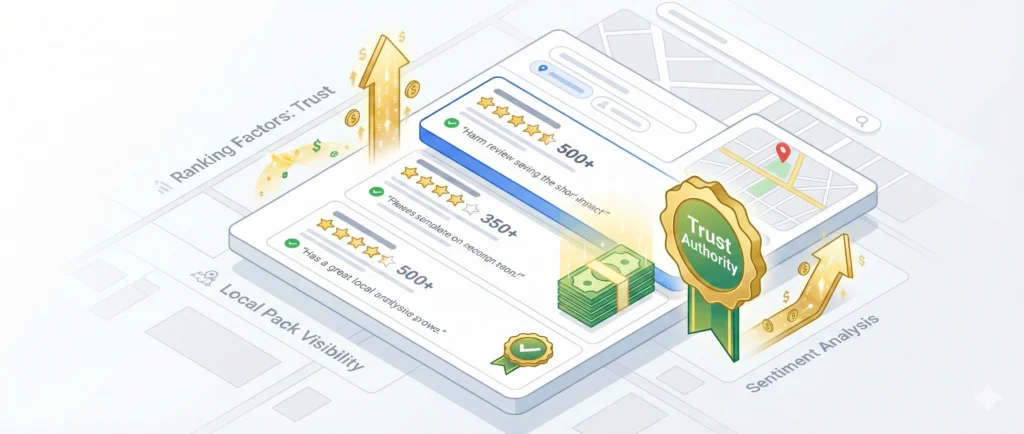
In the digital world, trust is everything. We call this “E-E-A-T” (Experience, Expertise, Authoritativeness, and Trustworthiness). For a local business, the biggest indicator of trust is customer reviews.
Reviews are the modern word-of-mouth. But in 2026, local SEO looks at reviews a bit differently.
It’s Not Just About 5 Stars
Of course, you want 5 stars. But Google actually reads the text of your reviews.
- Review A: “Great job.”
- Review B: “They did an amazing job fixing my leaking kitchen sink, and the plumber arrived on time.”
Review B is gold for local SEO. Why? Because it contains keywords (“leaking kitchen sink,” “plumber”). It tells Google exactly what you do.
How to Get Better Reviews
Don’t be shy. When you have a happy customer, ask them for a review. You can even smoothly guide them: “We are so grateful you liked the service! Would you mind mentioning which service we did for you in your review? It helps other customers find us.”
Responding to reviews is equally important. If someone leaves a negative review, reply kindly and offer to fix it. This shows potential customers (and Google) that you care, which boosts your “Trustworthiness” score in local SEO.
Fixing Your Website: It’s All About “Local” Signals
While your Google Profile is the building, your website is the pillar. It needs to support your local SEO efforts.
You don’t need to be a web developer to understand the basics here. It mostly comes down to consistency.
The “NAP” Rule
NAP stands for Name, Address, and Phone Number. Your NAP information must be identical everywhere on the internet.
- If your website says “123 Main St.“
- And your Facebook says “123 Main Street.“
- And Google says “123 Main St, Suite 4.“
…Google gets confused. It might seem like a small detail, but inconsistent data makes Google worry that the info might be wrong, so they stop showing you in search results. Cleaning up your NAP is a quick way to improve your local SEO.
Talk Like a Local
When you write for your website, use language that locals use. Mention nearby landmarks, neighbourhoods, or specific boroughs. Instead of just saying “Best Coffee Shop,” try “Best Coffee Shop near Central Park.” This helps search engines understand exactly which community you serve, strengthening your local SEO.
Smartphones and Voice Search: Speaking Your Customer’s Language
We mentioned earlier that people use phones to search. In 2026, many people don’t even type—they talk.
“Hey Google, where can I get an oil change open on Sundays?”
Voice searches are usually longer and phrased as questions. This changes how we write content for local SEO.
Be Helpful, Not Salesy
To capture these voice searches, your content should answer questions directly. A great way to do this is to have a “Frequently Asked Questions” page on your website.
- “Do you offer same-day service?”
- “Is there parking nearby?”
- “Do you accept insurance?”
By writing these questions and answers down, you are giving the search engines the exact text they need to answer a voice search. This is a secret weapon in modern local SEO.
Also, ensure your website loads fast. If a customer is on a mobile data connection and your site takes 10 seconds to load, they will click the “back” button. Search engines notice this “bounce,” and it hurts your ranking.
Building Connections: How Local Links Work
In the world of standard SEO, getting a link from a big site like the New York Times mentions you. But in local SEO, we care more about the neighbourhood.
Think of a link as a “vote.” If the local tunnel of Commerce links to your website, that is a vote of confidence. It tells Google, “This business is a real, respected part of our community.”
How to Get Local Links
You don’t need to hire a fancy PR firm. You just need to be involved in your community.
- Sponsor a Team: Sponsor the local Little League baseball team. They will likely put your logo and a link on their website.
- Charity Events: Participate in a local food drive or charity run.
- Partner Up: Do you run a gym? Partner with a nearby health food store. You link to them, and they link to you.
These local connections build your authority in a specific geographic area. It creates a web of trust that is very powerful for local SEO.
Conclusion: One Step at a Time
The world of local SEO in 2026 can seem fast-paced and competitive. With AI, voice search, and mobile dominance, it feels like the rules are always changing.
But at its heart, local SEO hasn’t changed that much. It is still about connecting real people with real businesses. It is about being accurate, being helpful, and being trustworthy.
You don’t need to do everything at once. Start by claiming your Google Business Profile. Then, work on getting a few honest reviews. Next, check your website for accurate contact info.
By taking these small steps, you build a foundation that will serve your business for years to come. Local SEO is an investment in your business’s future, ensuring that when a neighbour asks, “Where is the best place near me?”, the answer is you.
Also Read : How Gemini 3 Flash is rolling out globally in Google Search
Frequently Asked Questions (FAQs)
Q1: How long does it take for local SEO to work? A: Think of it like going to the gym. You won’t see muscles after one workout. Typically, local SEO takes 3 to 6 months of consistent effort to see a real increase in calls and visitors.
Q2: Do I really need a website, or is a Facebook page enough? A: You really need a website. While social media is great, a website gives you full control. It is also the central hub that Google looks at to verify your info for local SEO.
Q3: My business doesn’t have a storefront (I’m a plumber/electrician). Can I still do local SEO? A: Absolutely! You are what is called a “Service Area Business.” You can hide your home address on Google Maps, but still show up for searches in the cities you serve using local SEO strategies.
Q4: Can I pay Google to rank higher in the map pack? A: No, you cannot pay for the organic (free) map rankings. Those are earned through good local SEO. However, you can pay for “Local Services Ads,” which appear above the map pack.
Q5: Why did my ranking drop suddenly? A: This can happen for many reasons. A new competitor might have moved in, you might have received a negative review, or Google might have updated its rules. Consistent local SEO monitoring helps you catch these drops and fix them quickly.